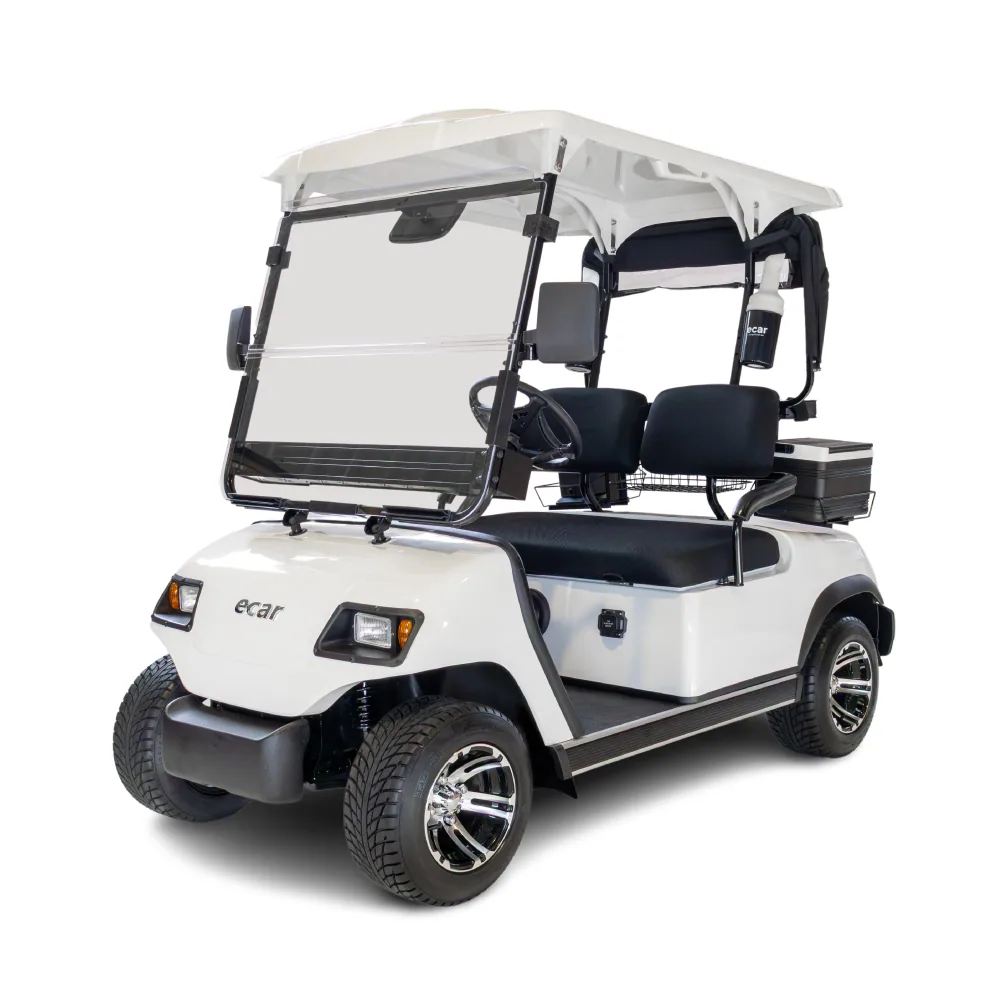
A golf cart AC motor is an alternating-current drive that is more efficient and needs less servicing than an older DC motor, and most new lithium golf carts now use one. If you are comparing carts, "AC" on the spec sheet is a good sign. This guide explains what AC and DC mean on a golf cart, how they differ in daily use, and which carts in our range have an AC motor.
What "AC" means on a golf cart
Every electric golf cart has a motor driven by a controller and a battery. The battery stores direct current (DC). In an older DC-motor cart, that direct current goes more or less straight to a brushed motor. In an AC-motor cart, the controller converts the battery's DC into alternating current to drive an AC motor.
| Feature | DC motor cart | AC motor cart |
|---|---|---|
| Motor type | Brushed DC motor | AC induction motor |
| Efficiency | Lower | Higher, so more range from the same battery |
| Brushes to wear out | Yes | No |
| Regenerative braking | Rare | Common, which helps on hills |
| Upfront cost | Lower | Higher |
| Typical age of cart | Older and ex-lease carts | Most new lithium carts |
AC vs DC: the practical differences
Efficiency and range
An AC drive wastes less energy as heat, so the same battery goes further. That matters most with lithium batteries, because you are paying for every kilowatt-hour you carry. The AC carts in our range list ranges from 60 km to 95+ km per charge, depending on the cart and its battery.
Servicing and wear
A brushed DC motor has carbon brushes that wear and need replacing. An AC motor has none, so there is one less routine job. Both types still need the same basics: tyres, brakes, wheel bearings and a healthy battery.
Braking and downhill control
Many AC drives can slow the cart on a descent by feeding energy back to the battery. That gives smoother, more controlled downhill driving than a DC cart that relies on its mechanical brakes alone.
Golf carts in our range with an AC motor
These carts list an AC motor in their specifications:
| Cart | Price | Motor | Battery | Range |
|---|---|---|---|---|
| Ex-Fleet E-Z-GO RXV 48V Lithium 2-Seat Cart (Refurbished) | $6,490 | 48V AC Induction Motor | Brand-New 48V Drop-In Lithium Pack | 70+ km Per Charge |
| Cougar 2-Seater Electric Golf Cart | $7,450 | 48V 3.8kW AC Electric Motor | 48V Deep-Cycle Battery Pack | 60+ km Per Charge |
| ECAR Lithium A2 2-Seater Golf Cart | $10,990 | 48V 4.0kW High-Efficiency AC Motor | 48V 105Ah LiFePO4 Lithium | 80+ km Per Charge |
| Rippa 4-Seat Electric Golf Cart Australia | $12,990 | 48V 4.0kW AC Motor | 48V 100Ah Lithium LiFePO4 | 75+ km Per Charge |
| ECAR Lithium A4 4-Seater Golf Cart | $13,990 | 48V 4.0kW Toyota AC System | 48V 105Ah LiFePO4 Lithium Battery | 80 km Per Charge |
| ECAR Lithium Magnum 4LR Lifted 4x4 Off-Road Cart | $16,990 | 48V 5.0kW High-Torque AC Motor | 48V 105Ah Deep-Cycle Lithium | 70+ km |
| Tomberlin E-Merge SS 4-Seat Luxury Saloon Cart | $27,990 | 48V 5.0kW AC High Performance Motor | 48V 105Ah Premium Lithium LiFePO4 | 90+ km Per Charge |
| Garia Lithium Luxury Golf Cart (Danish Handcrafted) | $62,500 | 48V 3.0kW Ultra-Quiet AC Drivetrain | Samsung SDI Lithium High Capacity Pack | 95+ km Single Charge |
See the full golf cart range, or read about ECAR golf carts, where the A2, A4 and Magnum list AC systems.
When DC still makes sense
A DC cart is not a bad cart. Older carts are often simple to repair, widely supported and cost much less to buy. Check each cart's specification to see which motor it has: our used carts start at $4,990 for the Used Yamaha G29. If your budget is under $7,450, our used golf carts are the place to look.
Reading a cart's spec sheet
Three numbers tell you most of what you need: the motor rating in kilowatts, the battery voltage and the battery capacity. Battery energy in kilowatt-hours is volts multiplied by amp-hours, divided by 1,000. A 48V 105Ah pack holds 5.04 kWh. Here is the maths for the AC carts we list:
| Cart | Motor | Battery | Energy (kWh) | Listed range |
|---|---|---|---|---|
| Ex-Fleet E-Z-GO RXV 48V Lithium 2-Seat Cart (Refurbished) | 48V AC Induction Motor | Brand-New 48V Drop-In Lithium Pack | - | 70+ km Per Charge |
| Cougar 2-Seater Electric Golf Cart | 48V 3.8kW AC Electric Motor | 48V Deep-Cycle Battery Pack | - | 60+ km Per Charge |
| ECAR Lithium A2 2-Seater Golf Cart | 48V 4.0kW High-Efficiency AC Motor | 48V 105Ah LiFePO4 Lithium | 5.04 | 80+ km Per Charge |
| Rippa 4-Seat Electric Golf Cart Australia | 48V 4.0kW AC Motor | 48V 100Ah Lithium LiFePO4 | 4.80 | 75+ km Per Charge |
| ECAR Lithium A4 4-Seater Golf Cart | 48V 4.0kW Toyota AC System | 48V 105Ah LiFePO4 Lithium Battery | 5.04 | 80 km Per Charge |
| ECAR Lithium Magnum 4LR Lifted 4x4 Off-Road Cart | 48V 5.0kW High-Torque AC Motor | 48V 105Ah Deep-Cycle Lithium | 5.04 | 70+ km |
| Tomberlin E-Merge SS 4-Seat Luxury Saloon Cart | 48V 5.0kW AC High Performance Motor | 48V 105Ah Premium Lithium LiFePO4 | 5.04 | 90+ km Per Charge |
| Garia Lithium Luxury Golf Cart (Danish Handcrafted) | 48V 3.0kW Ultra-Quiet AC Drivetrain | Samsung SDI Lithium High Capacity Pack | - | 95+ km Single Charge |
A higher kilowatt rating means more power for hills and loads. A bigger battery means more range. Neither matters much if the controller and motor are poorly matched, which is why a maker's listed range on your kind of terrain is worth asking about.
Common myths about AC and DC carts
- "AC carts are always faster." Top speed is set by the controller and the cart's limits, not by the motor type alone.
- "DC carts cannot climb hills." A well-specified DC cart climbs fine. AC drives are usually smoother and more efficient on a climb.
- "An AC cart never needs servicing." There are no brushes to replace, but tyres, brakes and the battery still need care.
- "Lithium means AC." Not always. Battery chemistry and motor type are separate choices, so check each.
Questions to ask before you buy
- Is the motor AC or DC, and what is its power rating in kilowatts?
- What battery does it use, and what is the warranty on the battery?
- Does the cart have regenerative braking?
- What range does the maker list, and on what terrain?
- Can you service it locally, and are parts easy to get?
Our guide to lithium versus lead-acid batteries covers the battery side of the same decision. For help choosing, call 0480 811 308.