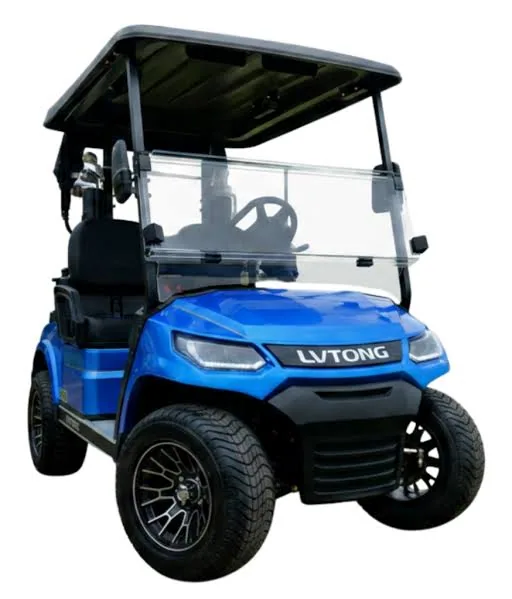
Golf cart registration in QLD works through conditional registration. Queensland treats a motorised golf buggy as a non-standard recreational vehicle, so the Department of Transport and Main Roads (TMR) can register it conditionally when there is a genuine need for limited access to the road network. A golf buggy used only on a golf course needs no registration. This guide explains the pieces in plain language, with links to the official sources, so you know what to confirm before you buy a cart.
Can you drive a golf cart on the road in Queensland?
Only in limited circumstances. The Queensland Government lists "Golf buggy (or derivative)" among its conditional registration information sheets for recreational vehicles, and describes the catalogue as covering non-standard vehicles that do not comply with standard registration rules and have "a genuine need for limited access to the road network". Registration alone is not the whole answer: the road owner has to agree, and some conditions also need a police permit.
When is a golf buggy exempt from registration?
Queensland lists vehicles that do not need registration in the regulation. As summarised in a council policy (Isaac Regional Council, effective 26 June 2024), the list includes a motorised golf buggy or other motorised machinery being used on a golf course or on a golf course car park, or a motorised golf buggy being used for directly crossing a road dividing a golf course. If your cart never leaves the course, its car park or a direct crossing of a road through the course, the exemption is the relevant rule.
How does conditional registration work for a golf buggy?
| Topic | What the Queensland sources say |
|---|---|
| Who registers it | TMR issues conditional registration for non-standard recreational vehicles |
| Condition codes | A golf buggy can be conditionally registered under location codes LO3, LO6(A) and LO7 |
| Road owner permission | LO3 and LO6(A) registrations need permission from the road owner or manager, whatever the land tenure |
| Police permit | LO6(A) needs authorisation from the road authority and a Queensland Police Service permit |
| Application paperwork | TMR form F5390 (single rear plate) asks for a copy of the authorisation letter and the police permit |
| Local roads | Councils manage local roads, so you need council permission to drive a golf buggy on one |
| Number plate | Owners of conditionally registered golf buggies can apply to display one plate, at the rear only |
Each code limits where the vehicle may operate, and the information sheet sets the exact conditions. Read the current sheet on the Queensland Government recreational vehicles page and the TMR form F5390 before you lodge anything.
What does this mean when you buy a cart?
The carts in our range that carry a road-compliance note in their specifications are:
| Cart | Seating | Top speed | Range | Price |
|---|---|---|---|---|
| Rippa 4-Seat Electric Golf Cart Australia | 4-Passenger | 25 km/h | 75+ km Per Charge | $12,990 |
| Tomberlin E-Merge SS 4-Seat Luxury Saloon Cart | 4-Passenger Diamond Stitched Luxury Seats | 38 km/h | 90+ km Per Charge | $27,990 |
| Garia Lithium Luxury Golf Cart (Danish Handcrafted) | 2-Passenger Hand-Stitched Scottish Leather | 30 km/h | 95+ km Single Charge | $62,500 |
A "conditional road compliant" note describes the cart's equipment and speed; it does not approve your route. In Queensland the route and the permissions come from the road owner and, for LO6(A), the police. Plan the trip you actually want to make, then ask the council and TMR whether it can be approved.
Checklist before you buy in Queensland
- Write down the exact roads you want to drive and who owns them (council or state).
- Ask the road owner whether they will authorise a golf buggy on that route.
- Ask the Queensland Police Service about a permit if the conditions need one.
- Read the golf buggy information sheet and form F5390 for the codes that apply.
- Choose a cart whose seats, speed and equipment match those conditions.
How does Queensland differ from NSW and Victoria?
| Topic | NSW | Queensland | Victoria |
|---|---|---|---|
| Basic approach | Golf buggy medical concession through conditional registration | Conditional registration under location codes such as LO3, LO6(A) and LO7 | No registration if the cart stays off the road system and meets the exemption |
| Seats | Two seats only | Set by the golf buggy information sheet | Not specified in the exemption |
| Speed | 20 km/h maximum | Set by the conditions of the code | Highway use limited to two kilometres at a time in one direction |
| Permission | Medical evidence at a Service NSW centre | Road owner, plus a police permit under LO6(A) | Unregistered vehicle permit for a one-off road trip |
Sources: Transport for NSW, Queensland Government and Transport Victoria. The three states take three different approaches, so a rule you read for one does not carry over to another.
Common mistakes buyers make
- Assuming lights make a cart road legal. Equipment helps, but in Queensland the route, the road owner and sometimes the police decide.
- Skipping council permission. Councils manage local roads, so ask yours before you apply for anything.
- Buying first and asking later. A short call to the road owner before you buy can save you from a cart you cannot use as planned.
- Forgetting the exemption is narrow. It covers the golf course, its car park and a direct crossing of a road dividing the course, not the street outside.