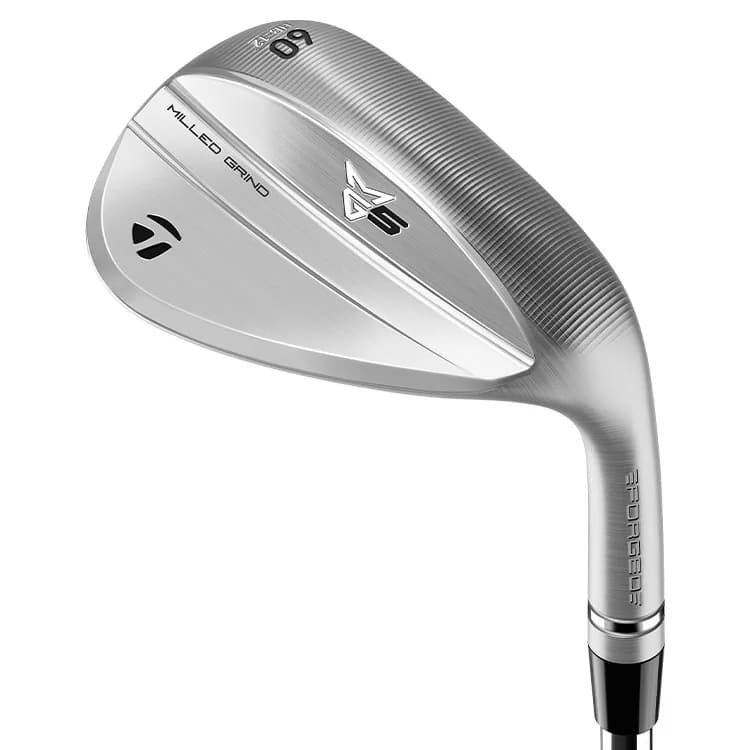
The degrees for a pitching wedge are typically 44 to 48 degrees of loft, a gap wedge 50 to 52, a sand wedge 54 to 56 and a lob wedge 58 to 62 degrees. Loft is the number stamped on the club, and it decides how high and how far the ball flies. This guide explains wedge degrees, loft and how many wedges to carry.
Wedge degrees at a glance
| Wedge | Typical loft | What it does best |
|---|---|---|
| Pitching wedge (PW) | 44 to 48 degrees | Full shots into the green and long chips |
| Gap or approach wedge (GW, AW) | 50 to 52 degrees | Fills the distance gap between pitching and sand wedge |
| Sand wedge (SW) | 54 to 56 degrees | Bunker shots and short pitches |
| Lob wedge (LW) | 58 to 62 degrees | High, soft shots over hazards to a short pin |
Lofts vary by maker, so check the number stamped on your own clubs.
What is loft in golf?
Loft is the angle of the clubface relative to vertical. More loft launches the ball higher and shorter with more backspin. Less loft sends it lower and further. A driver is about 9 to 12 degrees, and a lob wedge can reach 60 degrees or more. The difference between the lofts in your bag is what gives you different distances.
Pitching wedge degrees
The pitching wedge is the highest-lofted club in most iron sets. Modern sets use stronger lofts than older ones, so a pitching wedge in a new game-improvement set can sit near the bottom of the 44 to 48 degree range. That is why it pays to know the actual loft of your own pitching wedge before you add other wedges.
Gap (approach) wedge loft
A gap wedge, also called an approach wedge, sits between the pitching wedge and sand wedge. If your pitching wedge is 46 degrees and your sand wedge is 56 degrees, there is a 10 degree gap and a big drop in distance between them. A gap wedge of about 50 to 52 degrees fills it.
Sand wedge degrees
A sand wedge is usually 54 to 56 degrees, though sets range from 52 to 58 degrees. It is designed for bunker shots, where its sole helps the club glide through the sand, and it is also used for short pitches around the green.
Lob wedge: 58, 60 and 62 degrees
A lob wedge is for high, soft shots, such as a ball landing on a green with no room to roll. It is harder to hit consistently, so many golfers carry a 58 or 60 degree wedge rather than a 62. Try before you commit: a lob wedge you cannot control costs strokes.
How many wedges should you carry?
A common set-up is a pitching wedge, a gap wedge and a sand wedge, with a lob wedge added if you want one. Aim for about 4 to 6 degrees between wedges so each gives a different distance. Remember the 14-club limit in the Rules of Golf, so adding a wedge may mean leaving something else out. If you can, get fitted: a fitter can check your lofts, lie and bounce.
Wedge bounce in plain English
Bounce is the angle between the leading edge of a wedge and the lowest part of its sole. More bounce stops the club digging into soft sand or turf. Less bounce suits firm ground and tight lies. Sand wedges commonly have more bounce than pitching wedges, which is part of why they work well in bunkers.
Example wedge set-ups
| Set-up | Wedges | Gaps between wedges |
|---|---|---|
| Three wedges | 46 (PW), 52 (GW), 58 (SW) | 6 degrees each |
| Three wedges, higher loft | 48 (PW), 54 (GW), 58 (SW) | 6 then 4 degrees |
| Four wedges | 46 (PW), 50 (GW), 54 (SW), 58 (LW) | 4 degrees each |
These are examples only. Start from the loft of your own pitching wedge and work out from there.
Common wedge mistakes
- Carrying two wedges with the same loft and no gap wedge.
- Carrying a lob wedge you cannot hit consistently.
- Never checking the actual loft on a new set's pitching wedge.
- Ignoring bounce on a course with soft bunkers or hard fairways.
Which wedge should you add first?
| If your... | Add | Why |
|---|---|---|
| Set has only a pitching wedge | A sand wedge | Bunkers and short shots need more loft |
| Pitching wedge is under 46 degrees and you have a sand wedge | A gap wedge | Fills the distance between them |
| Short game is solid and you play courses with fast greens | A lob wedge | High, soft shots to tight pins |
Glossary: wedge terms
- Loft: the angle of the face, which controls height and distance.
- Bounce: the angle that stops the sole digging into the ground.
- Grind: the shape of the sole, which changes how the wedge plays in different lies.
- Gapping: spacing your wedge lofts so distances are evenly spread.
Our golf wedge
We stock a Golf Wedge at $199. See our golf wedges and putters, read about what golf clubs you need and how to choose an iron set, or browse every golf club set. Questions? Call 0480 811 308.